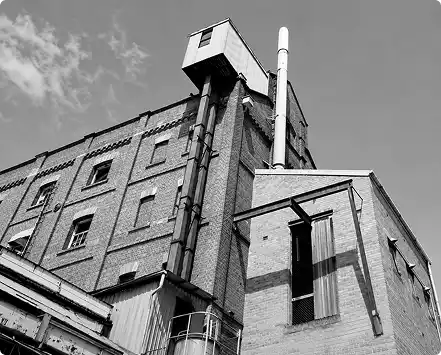
Leaving such significant structures neglected not only risks losing priceless history but also stalls the cultural activation of our local streets. Community efforts are growing to urge stakeholders and local government to step in, secure funding, and find adaptive reuse solutions that can breathe new life into this magnificent precinct while fully respecting its heritage status.
The historic fabric of Port Adelaide belongs to everyone who lives, works, and walks through these historic streets. When landmark precincts like the Customs House and Hart’s Mill are protected and thoughtfully restored, they create thriving community spaces, boost cultural tourism, and provide a unique sense of place that modern suburbs simply cannot replicate.
The Harts Mill precinct, located on Prince’s wharf, is one of the most recognisable, iconic and beloved precincts in SA. Built in 1855 and operating until 1980, Former Hart’s (later Adelaide Milling Co.) Flour Mill, Port Adelaide, is situated alongside the prominent Troubridge loading ramp, itself an important part of the South Australian history, the Jervois Bridge Keepers Gallery and the surrounding remnants of working wharves and boat mooring pylons.
Captain John Hart, a prominent early business and political figure who established and owned the mill is an important part of South Australia’s Colonial development and identity. Three times Governor of South Australia, he was a rare business man who paid his employees equally, irrespective of colour or creed. The entire Hart’s Mill precinct includes the wharves, the tie up pylons off the Copper Company wharf, the car-marshalling areas surrounding the mill buildings, Hart’s Mill (1854), Adelaide Milling company building, the flour mill, the Copper Company wharf, and the Jervois Bridge gallery, and the Troubridge roll on, roll off loading ramp.
The wharf was heavily tied to South Australia’s booming agricultural exports. The massive flour mills and warehouses of the Adelaide Milling Company were erected directly at the back of Princes Wharf to seamlessly load grain onto these waiting vessels.
In reality, Port’s ‘Prison Bar’ guernsey design was based on the pylons from the wharves, testifying to the strong community sense of the Port over time. According to Mathew Richardson, (Port Adelaide Football Club Chief Executive), “It is special that we can celebrate our history using the wharf pylons, which are such an iconic feature of our heartland. Our history is entwined with that of the Port and its wharves.”
More recently the precinct has been used for festivals, markets and exhibitions. It is one of the most significant and recognisable remaining colonial precincts, important to preserve in its entirety.
Preserving our maritime heritage goes beyond maintaining old brick and timber; it is about keeping the stories of our working-class pioneers alive. Today, the precinct surrounding Hart’s Mill serves as a vibrant public space, but ongoing community advocacy is essential to protect the wider coastal skyline from unsympathetic modern high-rise developments that threaten its historic charm.
True preservation requires active community participation. We invite you to join local advocacy networks, attend upcoming town hall discussions, and use our online portal to voice your ideas for future heritage campaigns. Together, we can ensure that our local council prioritizes adaptive reuse projects that celebrate our proud maritime past while building a sustainable future.